-
2025-12-01
Introduction: Why Techniques Matter in Prompt Engineering
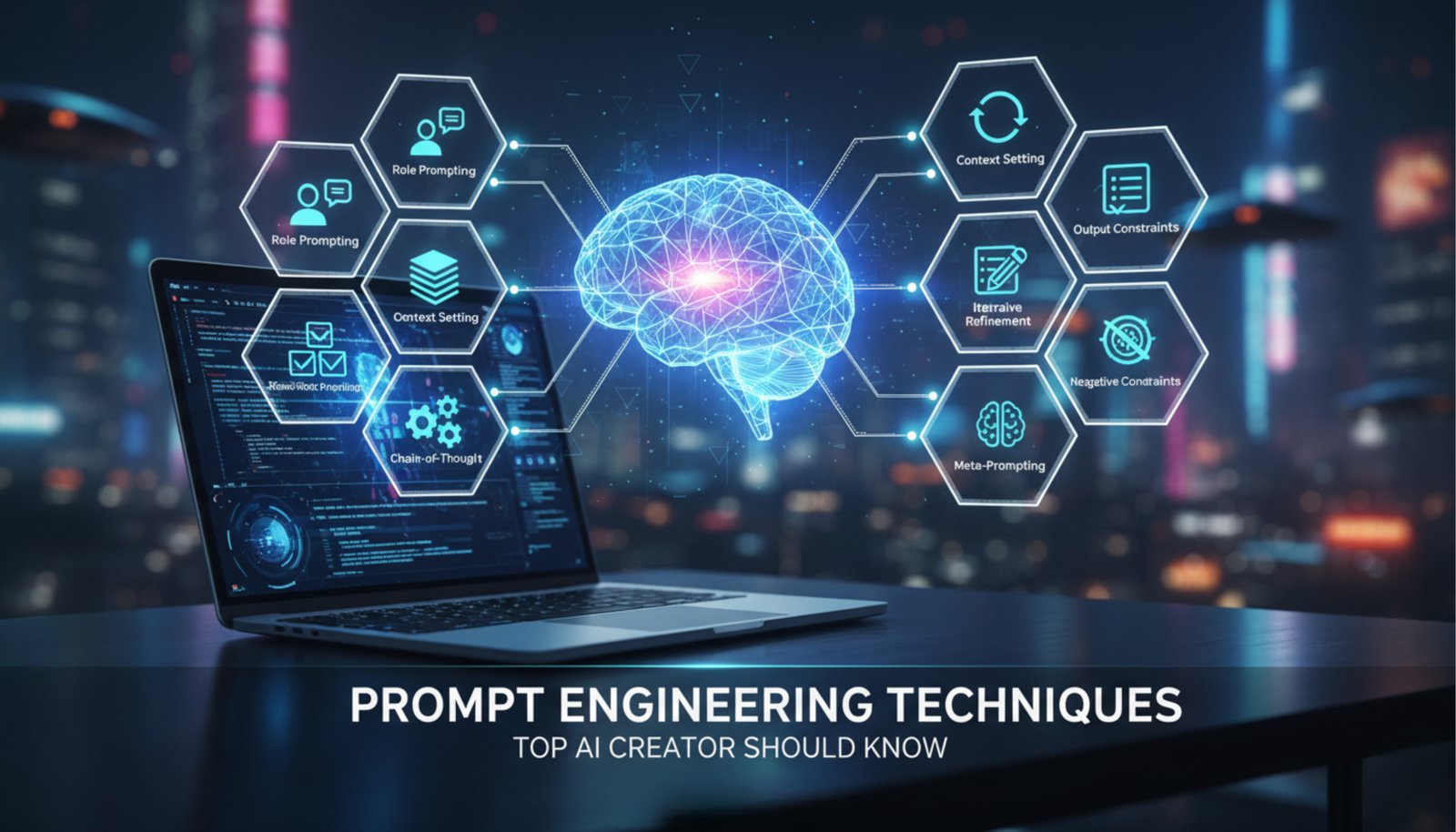
Prompt Engineering isn't simply typing instructions into AI. It's a strategic ability that dictates how well, creatively, and effectively AI models such as ChatGPT, Claude, or Gemini answer.
In 2025, AI creators, marketers, developers, and content experts depend on sophisticated prompt techniques to receive consistent, high-quality output.
This article covers top prompt engineering techniques that every AI creator should master to unlock AI’s full potential.
1. Role-Based Prompting
Definition: Assign a specific role to the AI to ensure it responds with domain-specific expertise.
Example:
“You are a financial analyst. Explain the quarterly earnings report for a SaaS company in simple terms.”
Benefits:
Produces responses aligned with the AI’s “persona”
Adds credibility and professional tone
Useful for niche domains like law, finance, or tech
2. Contextual Prompting
Definition: Give context background to enable the AI to comprehend context prior to posing a question.
Example:
"With the following product description, create a social media post that emphasizes its environmental aspects: [Insert Description]"
Benefits:
Minimizes irrelevant outputs
Ensures AI output is customized and accurate
Enhances AI understanding of complicated commands
3. Few-Shot Prompting
Definition: Provide the AI with a few samples prior to asking for similar output.
Example:
"Following are two examples of SEO blog headlines: 1) 'Top 10 AI Tools in 2025' 2) 'How AI Is Revolutionizing Marketing'
Now generate three more titles of similar style."
Benefits:
Leads AI to desired format and style
Decreases guesswork
Great for creative content and formatted outputs
4. Chain-of-Thought Prompting
Definition: Request the AI to reason step-by-step prior to providing the final answer.
Example:
"Describe step-by-step how to optimize an AI workflow for customer support, then summarize the main points."
Benefits:
Enhances reasoning accuracy
Outputs detailed, logical explanations
Suitable for complex problem-solving and technical work
5. Output Formatting
Definition: Indicate the preferred structure, format, or length of the AI output.
Example:
"Summarize this 10-page report in a bullet list of 5 key findings."
Benefits:
Decreases post-editing effort
Makes outputs business-ready
Facilitates integration into presentations, reports, or dashboards
6. Iterative Refinement
Definition: Regularly refine and adjust prompts by output performance.
Example:
"Your initial response is too technical. Rephrase it for a novice audience in plain language and using examples."
Benefits:
Tunes AI outputs with time
Enhances consistency
Creates a reusable prompt repository for varied tasks
7. Temperature & Creativity Control (Model Parameters)
Definition: Balance AI "creativity" levels (temperature settings) to regulate randomness in outputs.
Example:
Low temperature ? brief and factual
High temperature ? imaginative and exploratory
Benefits:
Balances creativity with precision
Suited for marketing copy vs. technical writeups
Suited for models where the parameters can be adjusted (e.g., OpenAI API)
8. Role + Constraints Combination
Definition: Pair role assignment with explicit constraints for precision.
Example:
"You are a social media manager. Write a 50-word Instagram caption emphasizing sustainability for Gen Z, using humor."
Benefits:
Guarantees outputs satisfy multiple requirements at the same time
Reduces ambiguity and redundant iterations
Excellent for professional content generation
9. Multi-Prompt Chaining
Definition: Divide a complicated task into several smaller prompts for step-by-step implementation.
Example:
Step 1: Summarize the report
Step 2: Identify key data points
Step 3: Create a marketing summary from data
Benefits:
Efficiently handles complicated workflows
Reduces AI mistakes in multi-step tasks
In coding, data analysis, and business reporting
10. Prompt Libraries & Reusability
Definition: Group prompts as reusable templates for different tasks.
Benefits:
Saves time for recurrent tasks
Standardizes outputs across teams
Facilitates sharing of best practices internally or with customers
Pro Tip: Maintain prompts organized by use case - i.e., Marketing, Coding, Data, Design.
11. Conclusion: Master Techniques, Maximize AI Potential
Prompt engineering isn't arbitrary it's a precise skill.
By becoming proficient in these techniques, AI developers can:
Enhance output accuracy and suitability
Save time and resources
Scale AI workflows across sectors
Whether you’re a marketer, developer, educator, or entrepreneur, these top prompt engineering techniques will make your AI work smarter, faster, and more effectively in 2025.
Ready to master these prompt engineering techniques?
Join Prompt Engineering Academy and start building professional AI workflows today.
Weekly trending

The Best AI Tools for Prompt Engineers (Free & Paid)
29-Oct, 2025