-
2025-10-28
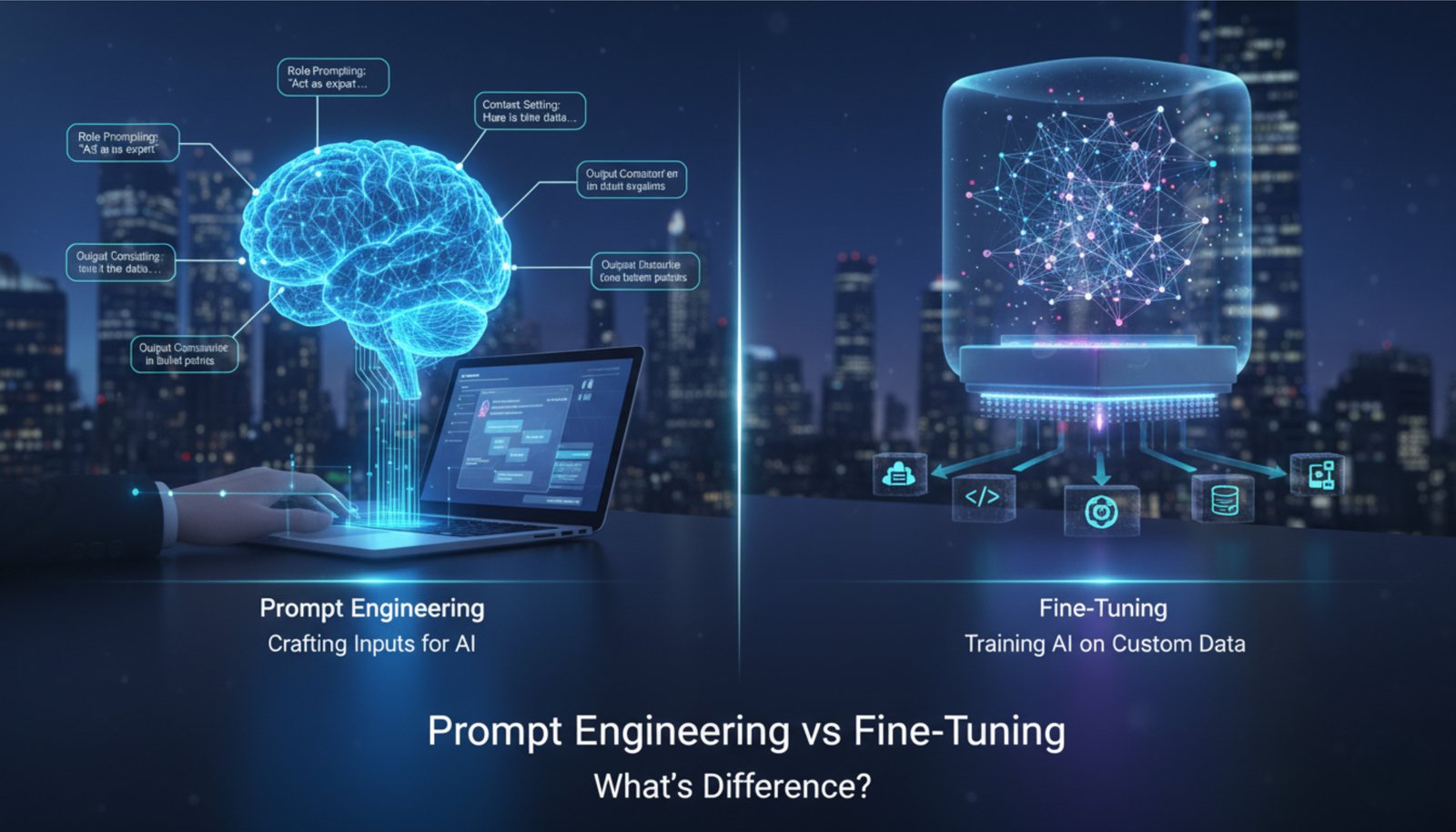
Introduction: Two Ways to Customize AI
Artificial Intelligence is transforming businesses, education, marketing, and software development. But to get the best results from AI models like ChatGPT, Claude, or Gemini, you often need to customize how the AI responds.
This is where Prompt Engineering and Fine-Tuning come in two distinct approaches that achieve similar goals in different ways.
In this guide, we’ll break down the differences, benefits, and best practices for each so you can make an informed choice in 2025.
What Is Prompt Engineering? (Quick Recap)
Prompt Engineering is the process of crafting precise instructions for AI to generate better output.
Key characteristics:
No changes to the AI model itself
Focused on writing effective prompts
Works with general-purpose AI models
Ideal for quick, flexible, and low-cost solutions
Example:
“Act as a professional SEO writer. Generate 10 blog post ideas on AI tools in 2025.”
The AI remains the same; only the instructions change to produce a desired result.
What Is Fine-Tuning?
Fine-tuning is the process of modifying the AI model’s parameters using domain-specific data so it performs better for a particular task.
Key characteristics:
Requires training data and technical setup
Modifies the AI model internally
Results in a specialized version of the model
Ideal for enterprise applications and highly specialized tasks
Example:
A company fine-tunes GPT on thousands of legal documents to create an AI that can draft contracts automatically with accurate legal terminology.
Key Differences Between Prompt Engineering and Fine-Tuning
When to Use Prompt Engineering
Prompt engineering is perfect for scenarios where you need:
Fast outputs for blogs, ads, or social media
Dynamic responses without training a new model
Experimentation with different styles or tones
Cost-effective AI usage
Example: Marketing teams creating multiple variations of ad copy in minutes using ChatGPT.
When to Use Fine-Tuning
Fine-tuning is ideal when:
You need consistent and highly accurate outputs
Working with sensitive or domain-specific data
The task requires AI expertise that general models can’t handle
You aim for long-term, large-scale automation
Example: A healthcare company fine-tuning an AI model on patient case studies to automatically summarize patient reports.
How They Complement Each Other
Prompt engineering and fine-tuning are not mutually exclusive — they often work best together:
Fine-tuned models handle complex, specialized tasks.
Prompt engineering optimizes output, tone, and style dynamically.
Scenario:
A legal firm fine-tunes an AI on contracts (fine-tuning) and then uses carefully crafted prompts to summarize each contract for clients (prompt engineering).
This combination ensures accuracy, efficiency, and flexibility.
Pros and Cons
Prompt Engineering
Pros: Low cost, fast, flexible, no coding required
Cons: May require multiple iterations, depends on model capabilities
Fine-Tuning
Pros: Highly specialized, consistent results, scalable for enterprise
Cons: Expensive, requires technical expertise, time-consuming
Future Trends in 2025
AI models are becoming easier to fine-tune via low-code platforms.
Prompt engineering is evolving into professional skill sets, with training programs, certification courses, and enterprise workshops.
Hybrid strategies (prompt + fine-tuning) will dominate enterprise AI workflows.
Businesses that master both approaches will maximize AI ROI and workflow efficiency.
Conclusion: Choosing the Right Approach
Quick tasks & content creation: Use Prompt Engineering
Industry-specific automation: Use Fine-Tuning
Best results: Combine both for maximum flexibility and precision
Mastering these strategies ensures that your AI outputs are reliable, accurate, and tailored to your business needs.
Weekly trending

The Best AI Tools for Prompt Engineers (Free & Paid)
29-Oct, 2025